
Evaluating a Door Service Vendor? Watch for These 7 Warning Signs First
July 27, 2026
It's 2 a.m. and a door won't close. Maybe it's an ICU entrance that's stuck half open. Maybe it's a loading dock door that's jammed on a Saturday shift. The person standing there is calling a commercial door company they've never talked to, hoping someone answers.
That moment tells a facility manager more about a door service vendor than any sales pitch ever will.
Most vendor evaluation content out there is either a company talking about itself or a generic checklist that could apply to any service contract. These are the specific signs that a commercial door repair relationship is headed for trouble, the kind facilities directors, maintenance managers, and healthcare operations leaders learn to spot the hard way. If a current vendor has these red flags, it might be time to look at other commercial door service options.
Red Flag 1: No Technician Credentialing or Background Checks
Start with who is actually showing up at the building and how they were vetted.
In this industry, the most meaningful credential is AAADM certification, the American Association of Automatic Door Manufacturers' training and testing standard. Unlike company-specific designations, AAADM certification validates a technician's skills against an independent, industry-wide benchmark.
For healthcare and multi-site facilities, this goes further than certification. Technicians need background checks and, in hospitals, hospital-level credentialing before they ever touch a security door or patient care area. If a vendor can't answer clearly and quickly when asked how their people are vetted, that's the first flag. A facility manager shouldn't have to chase down proof of who's walking through the building.
Red Flag 2: A New, Unfamiliar Face Every Visit
Some vendors have rotating staff. A different technician shows up for every door repair call, none of them know the building's quirks, and the facility manager ends up re-explaining the same history over and over.
That's both annoying and a real risk. A technician who's never seen a specific door setup has to relearn it from scratch, from the sensors down to the door closers, which means slower diagnosis and more guesswork on every service call. Some door repair companies outsource this work entirely, sending subcontracted labor instead of their own trained staff.
The alternative is consistency. Technicians assigned to the same buildings, who know the layout, the service history, and what's already been tried. Over time, that familiarity helps build trust, strengthens communication, and creates a true service partnership.
Red Flag 3: Vague or Missing Service Documentation
After a repair, a facility manager should walk away with something concrete, not a vague verbal "all set." If the paperwork doesn't show up, that's a problem waiting to surface later. 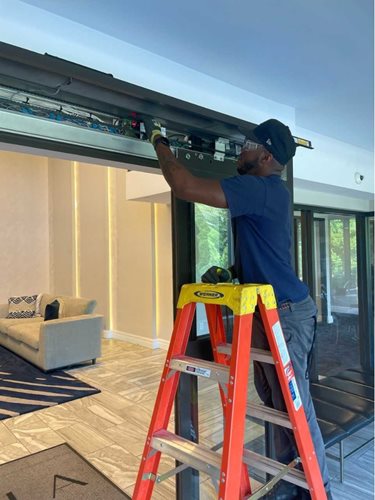
This matters most under pressure. When a fire marshal or a Joint Commission surveyor asks for fire door inspection records, they need more than a confirmation that it was completed. NFPA 80 requires fire door inspection reports to be kept for at least three years, with the date, findings, and technician's name and credentials on file. If a vendor can't produce that service documentation on request, the facility is exposed the moment someone official asks for it.
That's the real value of documentation. It's the difference between an audit that's routine and one that turns into a scramble.
Red Flag 4: Surprise Line Items on the Invoice
A quote for the commercial door repair comes in one number. The invoice comes in higher, with charges nobody explained ahead of time.
This is the kind of thing that makes a maintenance manager dread opening an invoice, because now they have to defend it to their boss. A vendor worth keeping quotes a price for the door repair and holds to it. If something changes mid-job, they call before doing the work, not after. What's quoted should be what's paid.
Red Flag 5: Slow Response, Especially After Hours
Doors don't fail on a schedule. They fail at 6 p.m. on a Friday, or during a night shift, or in the middle of a snowstorm when nobody wants to be out.
A vendor whose technicians only show up promptly during business hours isn't built for this kind of work. Emergency response has to mean any hour, any day, for every door in the building. A door left broken overnight isn't just an inconvenience. In a hospital, it's a patient flow and safety issue. In any commercial building, it's a security gap.
If a vendor's idea of "24/7" comes with asterisks, that's worth noticing before the next storm hits.
Red Flag 6: Call Centers Instead of Direct Access to a Real Person
There's a specific kind of frustration that comes from calling a vendor in an emergency and getting routed through a national call center, a hold queue, and a script. What's needed is someone who already knows the building.
Big company phone trees waste the exact time a facility manager doesn't have. The better model is a direct line to a local manager or technician, someone who picks up, already has context, and can commit to a timeline on the spot. If getting help means navigating who you are going to talk to, that's a sign the vendor is built for scale, not for the person standing at the broken door.
Red Flag 7: "We Don't Service That Door or Brand"
A commercial property with multiple buildings and multiple vendors from past renovations shouldn't need a different specialist for every door brand.
If a vendor can only work on certain brands, that facility manager is stuck managing multiple service providers to keep every entrance running. A vendor who services all major manufacturers, not just the ones they originally installed, removes that burden entirely. One call should cover the automatic doors at the main entrance and the fire-rated door in the stairwell, regardless of who put them in originally.
What Good Actually Looks Like
Strip away the red flags and what's left is simple. One call. A technician who already knows the building. A fix, not a temporary band-aid. Documentation handed over without having to ask twice.
That's not a high bar. However, it's rare enough that when a facility manager finds it, they notice.
The door repair companies worth keeping are the ones who show up, explain what they found and what they did, and leave a paper trail behind them. No babysitting the vendor to make sure the job gets finished right. Just a partner who treats the building like it's their own problem to solve, not another service call in a queue.
If you're seeing these problems in your current setup, we'd welcome the chance to talk through a better solution.