
A New Door Designed for Behavioral Health Environments
May 15, 2026
Think about the last time you walked a behavioral health unit and mentally catalogued the risks.
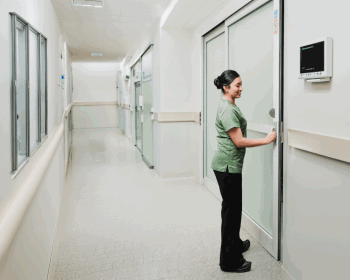
The swing door that can be wedged shut with a chair. The hardware that sticks out far enough to anchor something. The gap at the top of the door frame. The closer that could be removed if someone worked at it long enough. You have probably walked that checklist multiple times. And for years, the answer was the same: adapt a general-purpose door as best you can, add what you can add, cover what you can cover, and accept the rest.
That is the gap the Horton BH Slider™ was built to close.
Horton Automatics just released the Behavioral Health Profiler® ICU — the first sliding door system designed from the ground up for behavioral health environments.
Not adapted. Not modified. Engineered for this application specifically, with the five most critical facility safety requirements built in from the start.
Standard ICU sliding doors are built for infection control and staff access. They are not designed to prevent barricading, eliminate ligature points, or resist weaponization. The BH Slider™ is.
What the BH Slider™ Was Actually Designed to Prevent
The design brief for this product focused on five specific problems that behavioral health facility managers face every day.
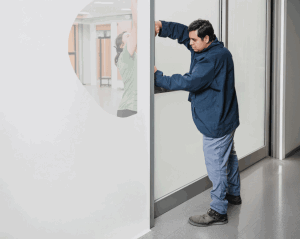
Patient barricading
A swing door can be held shut. A patient in acute distress can wedge a chair against it, lean into it, or use their body weight to delay staff access. Seconds matter in those situations.
The BH Slider™ moves laterally and cannot be barricaded the way a swing door can. The interior profile is flush, and the system includes an emergency override so staff can reach a patient when it counts.
Patient self-harm and ligature risk
A ligature point is any surface, gap, or protrusion where a cord, strip of fabric, or sheet could be attached and bear weight. Standard doors are full of them — hinges, closers, the gap above the door panel, pulls, handle hardware.
The BH Slider™ eliminates them. No pinch points, no exposed fasteners, no surfaces that create an anchor. The anti-ligature design runs through the entire system, not just the visible handle. Nothing to catch on, anywhere on the door.
Weaponization of door components
Hardware that can be removed or broken off is a safety risk for staff and for other patients. The BH Slider™ uses tamper-resistant components throughout. There is nothing on this door that is easy to take apart and turn into something it was not meant to be.
Staff harm
When a door can be barricaded and response time is delayed, staff are exposed. The BH Slider™ addresses staff safety as directly as it addresses patient safety. Unobstructed access is a core design requirement.
IV line entanglement
IV lines, tubing, and monitoring equipment are part of daily life in inpatient psychiatric settings. The BH Slider™ is designed to prevent these from catching or becoming entangled in door components during patient movement.
Why "Purpose-Built" Matters More Than It Sounds
When you adapt a standard product, you start with a set of assumptions — geometry, hardware mounting, frame profiles — that were not made with your application in mind. You add covers, remove components, substitute hardware. Each change is a workaround. Each workaround has a seam. 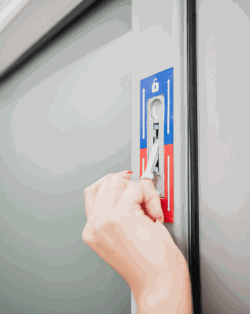
When you start from the application, none of that exists. The geometry is right from the beginning. The hardware was specified for this environment. There are no seams because there were no workarounds.
The BH Slider™ is compliant with UL 1784, UL 325, ADA, FGI Guidelines, and Joint Commission standards — not because those requirements were bolted on afterward, but because they were the design constraints from day one. A smoke-rated option is also available for units where that is required.
Anti-ligature compliance is not optional in behavioral health. The Joint Commission and CMS mandate it, and failure to meet environmental safety requirements can result in immediate jeopardy citations — one of the most serious survey outcomes, signalling that patient safety is at immediate risk and requiring correction before normal operations can continue. The documentation behind every safety decision matters as much as the decision itself. Manufacturer documentation confirming anti-barricade, anti-ligature, and anti-weaponization performance gives surveyors exactly what they need to see.
The strictest requirements apply in high-acuity areas where patients are not under constant one-to-one observation. Those are the spaces where the environment has to do more of the work. The BH Slider™ was built with that in mind.
What the Door Actually Looks Like
Another important point: the BH Slider™ does not look like a safety product.
That matters more than it might seem. Environments that look institutional increase patient agitation. Spaces that feel calm and considered support recovery. A room full of visible safety hardware signals threat. A room that simply looks well-designed does not. 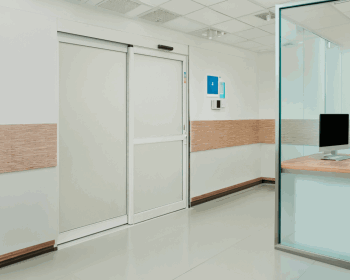
The BH Slider™ delivers all of its safety performance in smooth, flush finishes — full anodized aluminum or specialty paint. No exposed fasteners. No bulky hardware covers. Vision panels with tamper-proof safety glass. Optional controlled blinds between the glass panes for privacy and observation.
It fits the look of a facility that takes patient dignity seriously. That is not a small thing.
Configuration and What to Know Before Specifying
The BH Slider™ is a single slide system with 110-degree partial breakout. It is surface applied and available in manual operation or manual with mechanical self-closing. Door sizes go up to 9 feet wide by 8 feet high.
Common applications include inpatient psychiatric hospitals, rehabilitation and treatment centres, emergency room behavioral health suites, and court-ordered evaluation facilities. The system is compatible with electronic locking, building management systems, and patient management systems — so if your facility uses access control integration, the BH Slider™ can work within that infrastructure.
Being surface applied makes it viable for both new construction and renovation. If you are working on a renovation, an AAADM-certified installer can assess whether your existing opening dimensions and wall construction can accommodate the system before any specification decisions are locked in.
Architects specifying the product can access BIM files and use Horton's iSpecifyIt® tool directly on the product page at hortondoors.com.
Installation and Ongoing Service
Door Services Corporation is an authorized Horton Automatics installer. We have been supplying and installing Horton products in healthcare facilities for decades.
A door system like this only performs as designed when it is installed correctly and maintained on a schedule by AAADM-certified technicians trained for healthcare environments. Regular preventative maintenance also supports the documentation trail that surveyors and accreditation teams expect to see.
If you are specifying the BH Slider™ for new construction or a renovation, or if you want to talk through whether it fits your unit, contact your local Door Services team.