
How to Build a Business Case for Preventative Door Maintenance
September 24, 2026
We hear a version of this from facility managers constantly: you already know preventative maintenance is the right call. You have watched a commercial door fail at the worst possible moment, disrupted a shift, or triggered a compliance scramble nobody wanted. But knowing something makes sense and being able to defend it in a budget meeting are two different things. A budget owner needs more than “trust me.” They need a case that holds up without you in the room to explain it. One that connects your repair history to the real cost of reactive service, the risks of leaving problems unaddressed, and the evidence that supports a maintenance contract. Here’s how to build that case.
The Real Cost of Reactive Repair
Break-fix feels cheaper right up until the moment it isn't. A door that gets serviced only when it fails costs more than one that gets checked through regular maintenance, and the gap is bigger than most budget conversations account for. If your building runs on a Door Services Corporation automatic door maintenance contract, you typically save 25 percent in costs compared to running on emergency repair alone.
The reason is simple. A door that fails during business hours does not just cost the price of the repair. It costs the hours the door was down, the deliveries that waited, the staff that stood around a blocked entrance, and the emergency repair premium for a technician who has to drop everything to get there. None of that shows up on an invoice for the repair itself, which is exactly why it gets left out of the budget conversation. Pull your own repair history, and you will usually find the same pattern: a handful of emergency calls cost more, together, than a year of scheduled visits would have.
The Risk Side of the Case
Cost is only half the argument, and for some doors it is not even the bigger half. Automatic doors are governed by real standards, not just good intentions. ANSI/BHMA A156.10 and A156.19 set the safety thresholds for speed, force, and sensor response on power-operated pedestrian doors. ADA compliance sets requirements for activation zones, opening force, and timing at every entrance your visitors use. Fire door assemblies and access control systems carry their own inspection and testing mandates, Skip regular inspections, and you are risking a standard you did not know you were failing to meet.
A budget owner might tolerate a repair cost. They are far less willing to tolerate a compliance gap, a security exposure, or the fallout from an incident that traces back to a door system nobody was tracking. Put risk next to cost, and you are no longer asking for just a maintenance line item.
What to Bring Into the Room
A case is only as strong as what you can put in front of someone. Before the meeting, pull together three things. 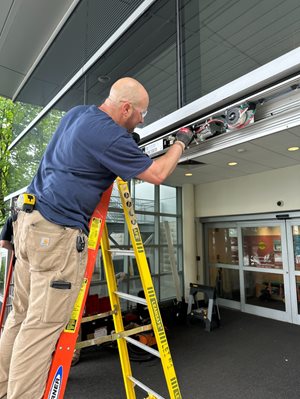
1. Gather your repair history across every door in the building: sliding doors, swinging doors, revolving doors and anything at an entrance or storefront. Every emergency repair, every after-hours service fee, every repeat visit to the same door tells a story on its own. Line them up by date and cost, and the pattern usually makes the argument for you before you say a word.
2. Document what is currently undocumented. If you do not know when your doors were last inspected against ADA, ANSI, or fire code requirements, that gap is itself part of the case. Every preventative maintenance visit our AAADM-certified technicians perform leaves behind a written inspection report and a service history log, documentation suitable for a compliance audit or an insurance review, not just a technician's notes. That kind of paper trail is what you need walking into a budget conversation, whether it comes from us or from tracking it yourself.
3. Translate the numbers into a single comparison. Take your reactive repair costs from the past year or two and set them next to what a maintenance plan would cost over the same period, fixing problems against preventing them.
Anticipating the Pushback
Two objections come up almost every time.
The first is "we will deal with it when it breaks." You already are dealing with it. Every reactive repair is proof the current approach has a cost. The only question is whether that cost stays predictable or shows up as a surprise at the worst possible time.
The second is "we don't have budget for this right now." This is where the risk case matters most. A commercial door maintenance program is a known, scheduled cost. An emergency repair is an unscheduled one that arrives without warning and usually costs more. The budget conversation is not about finding new money. It is about choosing which version of the cost you would rather control.
Walking In Ready
Once you build this case, you do not have to rebuild it from scratch next year. The numbers will change, but the argument holds. Reactive repair costs more than scheduled service, the risk exposure is real, and the documentation to prove both is something you can start collecting today. When your maintenance contract comes up for renewal, or your budget cycle rolls around again, you walk in with the same case, updated with a year of new evidence behind it.
If you're preparing for an upcoming budget cycle or evaluating whether a maintenance agreement makes sense for your facility, Door Services Corporation can help. Our team can assess your door inventory, review your service history, and provide recommendations that help you make a stronger case for proactive maintenance and long-term cost control.