
Facility Safety Today: Why Fire Protection and Security Both Matter for Risk Management
December 11, 2025
The safety landscape for commercial buildings is changing fast. Facilities Managers can no longer focus solely on locks or fire ratings. Today’s environments face a wider set of risks, from unauthorized access and after-hours intrusions to active threat scenarios, all while fire safety codes remain stringent and unforgiving. The result: both fire protection and security require dedicated attention, planning, and investment.
This isn’t about choosing one priority over the other. It’s about building a facility program that treats fire protection and security as essential components of life safety and risk management, each with its own requirements, systems, and best practices - and one door solution that delivers both!
Essential Component 1: Fire Protection—A Non‑Negotiable Life Safety Imperative
Fire protection remains a foundational responsibility. It governs how buildings are designed, segmented, and operated, day in and day out.
What matters most:
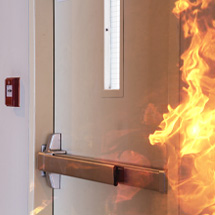 Certified assemblies: Doors, frames, and hardware that meet recognized standards (e.g., UL 10B/10C, NFPA 252) for fire and smoke resistance.
- Compartmentation: The ability to close off corridors and zones to slow fire spread and protect egress paths.
- Reliability in emergencies: Systems that activate automatically, close properly, and maintain ratings under heat and pressure.
- Ongoing compliance: Inspections, documentation, and maintenance to ensure code adherence and operational readiness.
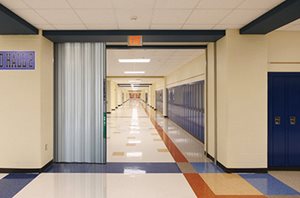 Typical applications:
- Corridor separations in schools, hospitals, and government buildings.
- Fire barriers between high-traffic public spaces and back‑of‑house areas.
- Rated assemblies in lobbies, stairwells, and vertical exits.
Essential Component 2: Security—Protecting People, Assets, and Operations
Security risks are dynamic and often time‑sensitive. Facilities need measures that deter, delay, and control, without sacrificing accessibility or daily flow.
What matters most:
 Layered access control: Physical barriers paired with credentials, schedules, and monitoring.
- Rapid lockdown capability: The ability to secure zones quickly and predictably when a situation escalates.
- Door systems fit for purpose: Solutions that withstand force, resist tampering, and include bullet resistant properties, all while supporting clear operational protocols.
- Integration with building systems: Alignment with alarms, video, and response procedures.
Typical applications:
- Main entries and lobbies that require after‑hours security.
- Sensitive zones (pharmacy, records, IT/data) needing higher protection.
- Government facilities and schools.
- Public‑facing spaces that must convert to controlled access quickly.
For facilities seeking advanced physical protection, Horton Automatic’s new resource is designed to help:

 New Resource: Next Level Facility Protection
Explore high‑security door solutions including Won-Door SteelGuard Sliding Accordion Security Doors, Horton HD-Ballistic Sliding Door Systems, and Horton ProSlide Blast Sliding Door Systems. These systems are engineered for environments where resilience and rapid control are essential.
Download the guide to review use cases, performance details, and selection considerations.
Balancing Both Priorities Without Compromise
Treating fire protection and security as separate components doesn’t mean operating in silos. It means acknowledging the different goals and performance criteria and aligning them intelligently:
- Clear objectives for each: Define what “success” looks like for fire (compartmentation, rating integrity) and for security (deterrence, controlled access, incident response).
- Smart zoning: Designate areas where fire protection is paramount (e.g., egress paths) and areas where elevated security is essential (e.g., sensitive rooms) and ensure each has the right system.
- Operational coordination: Train teams on both fire procedures and security protocols; test them together to avoid conflicts during real events.
- System compatibility: Select door systems and controls that won’t undermine one another. Where appropriate, consider integrated solutions that meet both needs—but only after evaluating whether dual‑function is truly the best fit for the space.
Practical Guidance: What to Evaluate in Each Category
Fire Protection Checklist
- Certifications: UL 10B/10C, NFPA 252, smoke control ratings
- Assembly integrity: Doors, frames, hardware compatibility
- Automatic activation: Closing devices and hold‑opens that release on alarm
- Maintenance plan: Scheduled inspections, documentation, and quick remediation
Security Checklist
- Door performance: Ballistic/blast resistance where required; forced‑entry resilience
- Access control: Credentials, schedules, audit trails, and escalation paths
- Response alignment: Lockdown procedures, alarm triggers, and monitoring
- Visibility and flow: Maintain accessibility and ADA compliance during daily operations
A Solution that Combines Fire Protection and Security
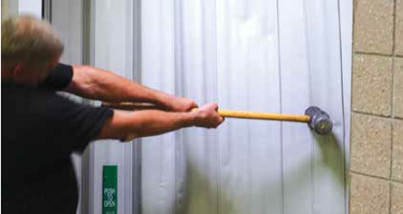 Won-Door SteelGuard™ is a dual-purpose horizontal sliding, accordion-type security and fire door that complies with stringent building codes and egress requirements while providing effective security and access control. Designed for interior environments, SteelGuard is an integral component of emergency response plans. It significantly reduces the impact of hostile events by enabling rapid facility lockdown within seconds. Facilities equipped with this system can quickly compartmentalize spaces, enabling swift response and mitigating threats, while maintaining authorized access for first responders.
Use Cases: Applying the Two‑Component Approach
- Education: Maintain fire-rated corridor barriers for safety while securing main entries, auditoriums, and gymnasiums for controlled access and rapid lockdown.
- Healthcare: Preserve life‑safety compartments for patient care and evacuation, while elevating security in pharmacies, labs, and data areas.
- Commercial & Public Buildings: Balance open public lobbies with after‑hours perimeter security and protect critical infrastructure zones without disrupting egress.
Why This Approach Can Work
Separating fire and security priorities can make it easier to:
- Hit the right standards without over‑engineering or under‑protecting.
- Simplify decision‑making by evaluating products against clear, distinct criteria.
- Improve long‑term performance through targeted maintenance and training.
- Build confidence among occupants, leadership, and regulators.
Next Steps
If you’re reassessing your facility’s safety protocols, start by mapping your spaces against where fire protection is essential and where elevated security is required. Then select systems that excel at their specific jobs.
 For advanced security planning and product selection, download this new guide, Next Level Facility Protection, featuring Won-Door SteelGuard, Horton HD-Ballistic, and Horton ProSlide Blast door systems.
DOWNLOAD THE GUIDE HERE or contact our team to discuss how to implement the right solutions for each priority in your building.
About Our Service and Install Solutions
We support Facilities Managers with both essential components:- Fire‑rated assemblies and life‑safety compartmentation support
- High‑security door systems for ballistic/blast resistance and rapid lockdown
- Integration guidance, inspections, and responsive service