
How To Connect Projects And Services Into a Long-Term Door Strategy That Actually Works
March 30, 2026
From One-Off Fixes to a Door Strategy You Can Defend
If Parts 1 and Part 2 were about getting individual doors and daily service under control, Part 3 is about building something that lasts.
Most facilities teams treat door installations and repairs as separate worlds. Projects get planned in one conversation. Service calls happen in another. The result is a patchwork of entrances managed reactively, with no clear story to tell when leadership asks why the same doors keep failing — or why the budget keeps getting hit.
This final part is about connecting those two worlds: turning installation decisions and service history into a cohesive, defensible plan that makes budgets easier to justify and audits easier to survive.
Let Chronic Service Issues Guide Your Next Upgrade
Not every door that needs repair is a candidate for replacement. But some are, and your service log already knows which ones.
When the same automatic sliding door generates repair call after repair call, that pattern is telling you something. It may have been the wrong door type for that opening. It may have been installed without enough thought for the traffic and conditions it would face. Or it may simply have reached the end of a reasonable service life. Whatever the cause, repeated failures at the same entrance are a signal worth acting on, not just a problem to patch.
Real World Example
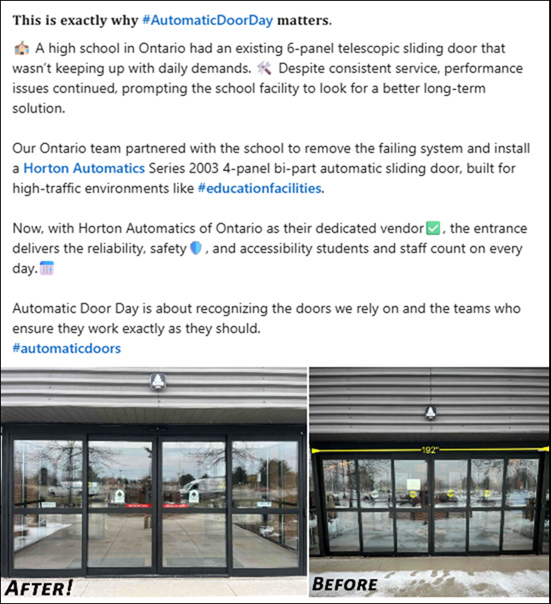
This Ontario high school project was originally shared on LinkedIn as part of #AutomaticDoorDay. It’s a snapshot of how chronic service issues can lead to smarter upgrade decisions when installation and service are connected.
View on LinkedIn
Now with a dedicated vendor, the result is an entrance that delivers reliability, safety, and accessibility students and staff count on every day.
That's exactly the kind of outcome that becomes possible when your service history informs your installation decisions.
Door Services Corporation is positioned to help you read that signal clearly because they handle both installation and service. When their technicians see the same door repeatedly, they can evaluate whether better maintenance can stabilize it or whether a smarter automatic door installation is the right next step. That's a different conversation than you get from a service-only vendor who has no stake in the installation decision, or an installer who won't be the one fixing it later.
The practical outcome: chronic service issues stop being a source of frustration and start becoming useful data that drives better upgrade decisions.
Want to see more stories like the Ontario high school project? Follow Door Services Corporation on LinkedIn for real-world examples of how smarter door decisions get made.
Plan Doors Like an Asset, Not a Nuisance
Every door has a life cycle: from installation to daily use, ongoing maintenance, and eventual replacement. Facilities teams that treat each of those stages as separate events end up reacting. Facilities teams that plan across the full lifecycle stay ahead.
A well-matched commercial door installation, done correctly, should deliver years of reliable performance with predictable maintenance needs. Preventive maintenance agreements extend that window and generate the documentation that supports future decisions. When a door's repair history clearly outpaces what ongoing service can fix, that record makes the case for replacement - no need to rely on memory.
Door Services Corporation supports this kind of planning directly. Their documentation from both project installations and service visits gives you a single, coherent record for each entrance: what was installed, how it has performed, what it has cost to maintain, and what the current recommendation is. That's the foundation of a capital plan that leadership can follow and finance can trust.
One Partner, One Story to Tell
Managing separate vendors for installation and service creates a predictable problem: when something goes wrong, the story gets complicated. The installer points to how the door has been maintained. The service vendor points to how it was installed. Your team is left in the middle, managing the friction while the door stays down.
A single partner across both sides of the door's life eliminates that dynamic entirely.
When Door Services Corporation installs a door, they're also the team that will service it. They know how it was configured, what the environment demands, and what normal performance looks like for that specific opening, whether it's a high-traffic automatic sliding door at a main entry, a security door in a sensitive area, or a commercial door in a back-of-house corridor. When something changes, they notice faster. When a repair is needed, they already understand the system.
For facilities managers, that means one point of accountability. One consistent story to bring to leadership. And the documentation to back it up.
A Simple Way to Start
You don't need to audit your entire portfolio to begin building a door strategy. Start with one building or one group of sites.
Within that scope, identify which entrances have been quietly reliable and which keep showing up in your repair history. That comparison, combined with Door Services Corporation's installation and service records, usually makes the path forward obvious.
The outcome is a straightforward map: which doors need better service coverage, which are candidates for upgrade or replacement, and which are fine as-is and can stay on a lighter maintenance schedule.
Once you have that picture for one area, repeating the process elsewhere is faster and more defensible, and you'll have the documentation to back up every decision you make along the way.
How Door Services Corporation Supports the Whole Picture
Across all three parts of this series, the throughline is consistent:- Install automatic doors that match real-world use.
- Maintain them with a preventative maintenance service agreement.
- Use repair history to decide when to adjust, upgrade, or replace.
If you're ready to move from one-off fixes to a door strategy you can defend, start with one building or group of sites. Door Services Corporation will help you map which doors need better service, which need upgrades, and which are fine as-is, and turn that map into a plan you can stand behind.